.png)
Notable 9: 9 Features That Make the Sunseeker X4 One of the Smartest Small Robotic Mowers on the Market
Robotic lawn mowers have come a long way from being niche gadgets for tech enthusiasts willing to tolerate a little frustration in exchange for convenience. Today’s best robotic mowers are increasingly practical, easier to live with, and capable of maintaining lawns in ways that often surprise homeowners the first time they see them in action.

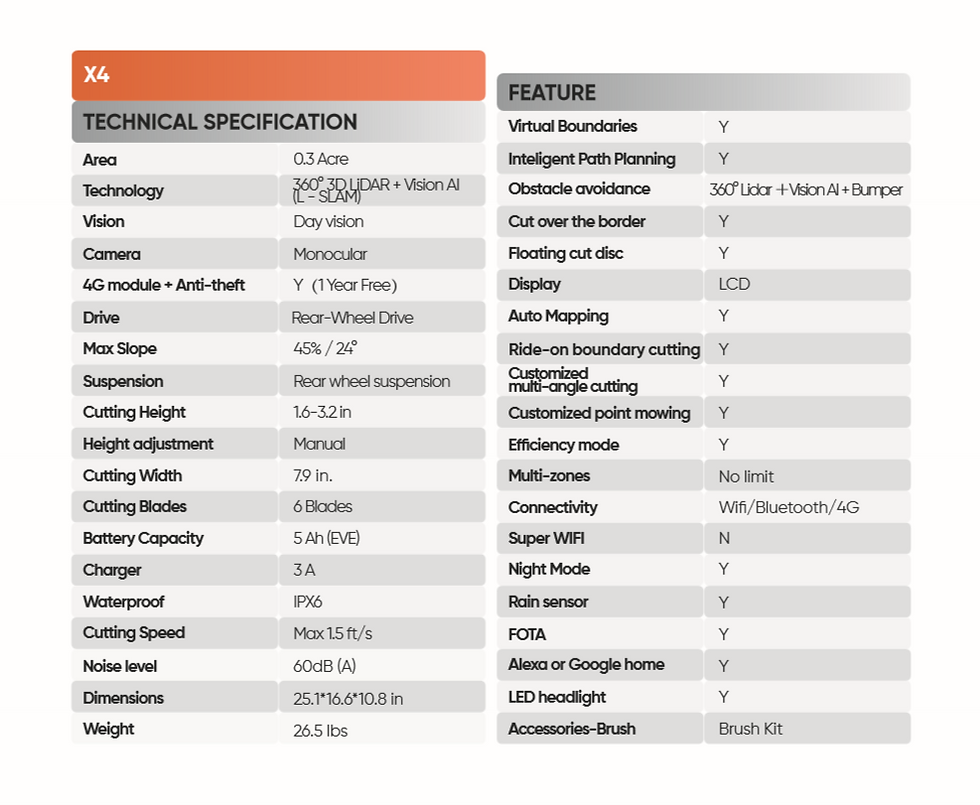
Among the growing number of wire-free options, the Sunseeker X4 has carved out an interesting place in the market. It is designed for lawns up to roughly 1/3 acre, but what makes it stand out is not simply the size it can handle. It is the way it approaches robotic mowing differently than both traditional boundary-wire systems and many newer GPS/RTK-powered robotic mowers.
Instead of requiring buried perimeter wire or depending on satellites and reference stations to understand where it is, the X4 relies on LiDAR and vision-based navigation to interpret and move through the yard.
That difference becomes more important than it may sound at first.
Real lawns are messy. Trees block sky visibility. Fences create awkward layouts. Side yards get narrow. Landscaping changes. Kids leave toys outside. Pets rearrange the backyard on their own schedule.
The X4 feels designed for those realities.
After spending time understanding how this mower behaves in actual yards, a few features consistently stand out—not as marketing buzzwords, but as things that genuinely make ownership easier.
Here are 9 of the best features of the Sunseeker X4 and why they matter in the real world.
# 1. Boundary Wire-Free Setup Without GPS And Reference Station Headaches
One of the most immediately noticeable differences with the X4 is what it doesn’t require: no buried boundary wire, no GPS satellite dependency, and no RTK reference station to function.

That combination matters more in real-world ownership than it might initially sound. Traditional robotic mowers typically force homeowners into one of two categories.
The first are boundary-wire robotic mowers, which require physically installing perimeter wire around the mowing area and obstacles. The second are wireless GPS/RTK robotic mowers, which rely on satellite positioning and a nearby reference station to maintain accurate navigation.
Both systems can work well—but both come with compromises.
Boundary wire mowers often involve a significant upfront installation effort. And while many systems can be surface-installed before burying the wire later, there is still a commitment involved.
Landscaping changes? Expanding a flower bed? Moving edging? Adding a decorative island? Suddenly the boundary system may need adjustments. Even worse, a damaged underground wire can turn into an unexpected troubleshooting project that nobody planned for.
GPS/RTK systems solve some of those headaches but introduce a different challenge: signal reliability.
Tree canopies, fences, roof lines, detached garages, neighboring structures, and narrow side yards can all interfere with satellite visibility. Some homeowners discover that “wire-free” does not necessarily mean “frustration-free,” particularly in neighborhoods with mature landscaping or properties surrounded by structures.
This is where the X4 separates itself.
Because it does not depend on GPS satellite positioning or RTK correction signals, it generally performs more consistently in difficult residential environments.
That means better performance in areas such as:
* Under mature tree coverage
* Near homes and fencing
* Tight side yards between houses
* Areas partially blocked by garages or buildings
* Properties where satellite visibility changes throughout the day
In many suburban neighborhoods, those are exactly the places where satellite-dependent robotic mowers struggle most.
Another underrated benefit of operating without boundary wire is flexibility between mowing areas.
Because the X4 is not physically trapped inside a buried perimeter system, it can travel across sidewalks, paved walkways, and driveways to reach additional mowing zones.
For homeowners with separated lawn sections, that matters.
Imagine a front yard separated from the backyard by a sidewalk or driveway. With many robotic mowers, those disconnected spaces either become a limitation or require awkward workarounds. The X4 can simply move between mapped zones when needed.

This flexibility also becomes useful for:
* Side-yard strips
* Lawn islands divided by pavement
* Detached sections of grass
* Fenced properties with separated mowing areas
There is one practical tradeoff worth mentioning here.
The X4 is software-limited to approximately 1/3 acre of mapped mowing area, making property size an important consideration.
For some homeowners closer to the 1/2 to 3/4 acre range, a practical alternative may actually be running two X4 units rather than stepping up to a larger mower that requires RTK signals, open sky visibility, or perimeter wire.
In some cases, the cost difference may not be as large as expected.
This can also be particularly useful for fenced properties. Instead of cutting access holes in fencing or leaving gates open between mowing sections—something many pet owners and parents understandably dislike—one mower can stay inside the fenced backyard while another handles the front or side yard independently.
And all of this naturally raises the next question:
If the mower does not depend on satellites, how exactly does it know where it is?
# 2. LiDAR + Vision Navigation That Handles Real Yards Better Than Expected

The answer lies in one of the X4’s biggest strengths: its LiDAR and vision-based
navigation system.
Without getting overly technical, LiDAR works by continuously scanning the environment to understand distance, layout, and surrounding objects. Combined with onboard vision technology, the mower builds an understanding of the lawn in a way that feels noticeably different from GPS-first systems.
Rather than simply knowing coordinates, the X4 behaves more like a mower that is actively interpreting its surroundings.

In real-world use, that distinction matters.
A mower relying heavily on GPS positioning can become inconsistent when signal quality drops. Under heavy tree cover or close to structures, some RTK mowers may slow down, reposition repeatedly, or lose precision.
The X4 tends to feel more adaptable.
For example, narrow side yards between homes—spaces where satellite visibility can become unreliable—often feel more natural for the X4 to navigate because it is focused on what it sees around it rather than waiting for ideal signal conditions.
The same applies to:
* Tree-heavy properties
* Homes with roof overhangs
* Tight fenced spaces
* Properties with irregular shapes
* Areas close to garages or sheds
One small but noticeable observation during setup is that the mower often appears to “learn” the environment quickly in a way that feels intuitive rather than rigid.
Instead of behaving like it only understands fixed coordinates, the X4 feels like it is reacting to the yard itself.
That distinction becomes more valuable over time than many homeowners expect.
# 3. Smart Obstacle Avoidance for Real-Life Yards
No lawn stays perfectly clean all the time.
And frankly, most homeowners do not want to spend every day walking the yard before the mower starts.
This is where smart obstacle avoidance becomes less of a luxury feature and more of a practical ownership benefit.
Real yards contain things like:
* Kids’ toys left outside
* Dog toys and water bowls
* Lawn chairs and patio furniture
* Garden decorations
* Temporary outdoor setups
* The occasional forgotten garden hose
The X4 is designed to navigate around changing conditions rather than assuming the yard will always look exactly the same.
That flexibility matters because robotic mowing works best when it quietly blends into daily life—not when homeowners constantly have to babysit the machine.
A practical thing noticed over time with obstacle-aware systems is that the biggest benefit is often reduced interruptions.
Instead of constantly stopping because something moved, the mower can continue working while adapting around temporary obstacles.
That said, some common sense still applies. Small lightweight objects can still get moved around depending on placement and size. A tennis ball sitting in the middle of the lawn may not stay exactly where it started.
But compared to older robotic mowers that relied on bumping into obstacles before reacting, modern obstacle handling tends to feel far more polished in everyday ownership.
# 4. Smarter Mowing Patterns That Improve Lawn Appearance Over Time

One of the biggest misconceptions about robotic mowing is that homeowners are trading lawn appearance for convenience.
In reality, many robotic mower owners find the opposite happens.
The X4 focuses on frequent, lighter mowing cycles, which means the lawn is maintained consistently rather than repeatedly cut down after growing tall.
The result is often a yard that looks more “continuously maintained” than freshly mowed once a week.
Homeowners tend to notice:
* More even grass height
* A denser, healthier lawn over time
* Fewer clumps of clippings
* More consistent appearance between mowing days
And unlike older robotic mowers that wandered randomly, the X4 allows homeowners to choose from multiple mowing patterns depending on the look they prefer.
For those who like a manicured appearance, the mower can create clean parallel stripes, giving the lawn a polished look similar to what many homeowners try to achieve with traditional mowing.

Prefer something more decorative? The X4 can create a checkerboard-style mowing pattern, which can look especially sharp on visible front lawns.

Or, for homeowners who prefer a more natural appearance, there is the option for a carpet-like finish with little to no visible striping, creating a consistently even look across the yard.
And for anyone who would rather not overthink mowing patterns at all, the mower can also automatically determine the most efficient mowing direction while still using a structured parallel striping method.
That tends to work especially well on irregularly shaped lawns where one mowing angle may look cleaner than another.
Over time, this flexibility becomes more noticeable than many homeowners initially expect. It turns lawn maintenance into something customizable rather than one-size-fits-all.
# 5. Multi-Zone Management for Properties That Aren’t Just One Open Rectangle
Very few lawns are simple rectangles.
Most properties include some combination of front yards, fenced backyards, narrow side sections, or disconnected patches of grass.

The X4’s multi-zone management makes these layouts much easier to manage.
Instead of treating everything as one large mowing space, homeowners can divide the property into separate mowing zones with customized behavior for each one.

This becomes especially useful for:
* Front yards needing stronger curb appeal
* Backyard recreation areas
* Narrow side strips that grow slower
* Fenced sections of lawn
* Separated grass areas divided by pavement
One especially practical feature is that zones can be linked together into a single mowing workflow.
For example, the mower can finish mowing the front yard and immediately continue into the backyard or side zone without waiting for another schedule or command.
For homeowners, that means the lawn stays consistently maintained without requiring micromanagement.
At the same time, each zone can also be customized independently.
That means homeowners can choose:
* Different mowing schedules by area
* Different mowing patterns for each section
* More frequent mowing in high-visibility spaces
* Reduced mowing in slower-growing areas
For example:
* The front lawn could run parallel stripes twice per week
* The backyard could use a carpet-style finish with more frequent cutting
* A less visible side yard could mow on a lighter schedule altogether
This kind of flexibility tends to matter more after ownership begins than most people expect.
# 6. No-Go Zones Without Digging Wire or Redesigning Landscaping
One of the most underrated features of a modern robotic mower is not actually where it can mow—it is where it knows not to mow.
The X4 allows homeowners to create digital no-go zones, meaning certain areas can simply be excluded from mowing without adding physical barriers or installing additional boundary wire.

That may sound like a small convenience, but it quickly becomes one of those features homeowners end up using far more than expected.
Real yards change constantly.
Spring landscaping projects happen. New flower beds get added. Decorative mulch areas shift. Seasonal decorations show up. Kids get temporary play equipment. Backyard layouts evolve.
With a traditional boundary-wire mower, many of those changes can mean adjusting physical wire placement. Even with some RTK-based systems, remapping or repositioning reference zones may be required.
The X4 makes this far simpler.
Need to avoid:
* A newly planted tree?
* Decorative rock beds?
* Seasonal flowers?
* A garden expansion?
* A temporary inflatable pool during summer?
A no-go zone can usually solve the problem without turning yard changes into a weekend project.
One practical thing homeowners tend to appreciate after using digital exclusion zones is how flexible they become over time.
A flower bed that expands next season? Easy adjustment.
Outdoor furniture rearranged for a party? Quick update.
Holiday decorations going up temporarily? No permanent changes required.
Instead of the yard adapting to the mower, the mower adapts to the yard.
# 7. App Control & Scheduling That Makes Lawn Care Feel Almost Invisible
A robotic mower only feels convenient if ownership itself stays convenient.

That is where app control starts to matter.
The X4 connects through Wi-Fi, allowing homeowners to manage mowing schedules, zone behavior, mapping adjustments, and mower settings from a smartphone.
And while app features can sometimes sound gimmicky on paper, this is one area where they tend to become genuinely useful in daily ownership.
Because mowing is automated, most homeowners eventually stop thinking about lawn maintenance in terms of “when do I mow?” and instead think in terms of “the lawn just stays maintained.”
Need to adjust mowing because guests are coming over?

Quick schedule change.
Grass growing faster after a rainy week?
Increase mowing frequency.
Want the backyard cut before the weekend?
Simple adjustment.
For multi-zone properties, scheduling becomes even more useful because each zone can have its own mowing pattern and mowing schedule, or zones can be grouped together so the mower automatically transitions from one area to the next.
That flexibility matters because most lawns are not used the same way.
For example:
* A front lawn may benefit from neat striping for curb appeal
* A backyard may prioritize frequent maintenance for pets or kids
* Less visible areas may only need occasional upkeep
There is one honest limitation worth mentioning here.
The X4 relies on **Wi-Fi connectivity and does not include built-in 4G cellular connectivity as standard equipment**.
For many homeowners, this will not matter much. If the mower operates within strong home Wi-Fi coverage, the experience tends to feel seamless.
However, homeowners who travel frequently or want remote access while away from the property may want to consider the **optional 4G module upgrade**, which is available at additional cost.
That upgrade becomes more appealing for vacation homes, secondary properties, or homeowners who simply enjoy checking mower status remotely.
# 8. Quiet Operation That Fits Into Everyday Life
Traditional mowing tends to demand attention.
It is loud.
It interrupts conversations.
It dictates schedules.
And in many neighborhoods, it usually means someone nearby is mowing at the exact moment someone else wants peace and quiet.
The X4 changes that dynamic.
One of the most noticeable ownership benefits is simply how quiet robotic mowing feels compared to traditional lawn care.
Instead of planning around noise, the mower quietly works in the background.
That opens up practical advantages such as:
* Running early without waking neighbors
* Mowing while working from home
* Quietly maintaining the lawn while kids play outside
* Running during evenings when a gas mower would feel intrusive
Many homeowners eventually describe robotic mowing less as “doing lawn care” and more as having lawn care happen automatically in the background.
In real-world ownership, it becomes surprisingly easy to forget the mower is even operating until noticing a freshly maintained section of lawn.
For neighborhoods with close houses—or homeowners who simply dislike noisy equipment—that shift feels larger than expected.
# 9. Easy Maintenance and Surprisingly Low Cost of Ownership
Convenience only matters if maintenance stays manageable.
Fortunately, the X4 leans toward simplicity.
Unlike traditional lawn equipment, there is:
* No gasoline
* No oil changes
* No spark plugs
* No air filters
* No belts to maintain
Routine ownership generally comes down to:
* Periodic blade replacement
* Cleaning grass buildup from underneath the mower
* Keeping wheels reasonably clean
* Occasional software or firmware updates
Blade swaps are relatively straightforward, and because robotic mowers cut frequently rather than aggressively, wear tends to feel more gradual than on conventional mowing equipment.
The ownership math also changes over time.
Instead of fuel costs, robotic mowing primarily runs on electricity (Less than it costs to run an average size refrigerator).
Instead of spending time mowing every week, the mower handles maintenance automatically.
And compared to traditional boundary-wire robotic mowers, there is another long-term advantage: no buried wire repairs.
Anyone who has owned a perimeter-wire robotic mower for multiple seasons knows eventually something usually happens.
Aeration.
Edging.
Landscaping.
A shovel in the wrong place.
A broken underground wire can quickly turn into a frustrating troubleshooting session.
By eliminating boundary wire altogether, the X4 removes one of the most common long-term ownership frustrations robotic mower owners experience.
That does not mean ownership is maintenance-free—no mower truly is—but it does tend to be low maintenance in a practical, realistic way.
Final Thoughts: Who the Sunseeker X4 Is Best For?
The Sunseeker X4 is not designed to be the biggest robotic mower on the market.
And honestly, that is part of what makes it appealing.
It feels purpose-built for homeowners who want a smarter, lower-friction robotic mowing experience for appropriately sized properties, especially lawns with trees, fences, sidewalks, irregular layouts, or areas where GPS-based systems may struggle.
For homeowners within its approximately 1/3-acre mapped limit, the X4 checks a lot of practical boxes:
✔ No buried boundary wire
✔ No RTK reference station
✔ No dependency on GPS satellite visibility
✔ Flexible zoning and no-go areas
✔ Better operation around trees and structures
✔ Quiet day-to-day ownership
✔ Consistent lawn appearance with customizable mowing patterns
That said, the limitations should be acknowledged honestly.
The 1/3-acre software limitation means larger properties may need another solution—or in some cases, two X4 units if the property layout makes that practical.
For certain 1/2 to 3/4 acre properties, especially fenced or segmented lawns, running two X4s may actually make more sense than stepping into a larger mower that depends on buried wire, open sky visibility, or a dedicated RTK reference station.
Likewise, the lack of standard 4G connectivity may matter to homeowners wanting full remote access away from home, though the optional upgrade helps close that gap.

Ultimately, what makes the X4 compelling is not one flashy feature. It is the way multiple practical advantages come together to make robotic mowing feel easier, more adaptable, and better suited to the realities of residential lawns.
For the right homeowner and property size, it feels less like buying a gadget and more like quietly removing one recurring chore from life.
Where to Learn More or Buy a Sunseeker X4
The Sunseeker X4 is available through authorized Sunseeker robotic mower dealers. For homeowners interested in purchasing one, buying through a knowledgeable dealer can also help with setup guidance, replacement parts, and long-term support.


Comments